Toronto Letter Carrier's Annual Greeting
Christmas 1885
Canada Post's plan to phase out door-to-door mail delivery by 2019 is just the latest chapter in the story of Canada's 250 years of letter carrier service. This post explores the development of carrier service from 1764 to 1908 with specific reference to Acts and Regulations dealing with letter delivery.
A. 1764 - 1851 : Non-uniform Delivery Charges
Letter carrier service was available in British Canada as early as 1764 when letters arriving at Quebec from Montreal were delivered for one penny. Prior to 1851, there was no consistency in the charges paid when collecting letters at the post office or having the letter delivered by a letter carrier. Letter carrier charges were at the discretion of the local postmasters.In 1846 for example, the letter carrier fee in Quebec was 2d., while a 1d. per letter gratuity was paid for letter carriers in Montreal, Toronto, and Kingston.
B. 1851 : Province of Canada Penny for City Delivery
In 1851, Great Britain granted control of the Post Office to the colony of the Province of Canada. On April 6, 1851, the Post Office Law of 1851 passed by the Canadian Provincial Parliament, came into effect. Among its many provisions, the Act authorized Postmasters to employ letter carriers for the delivery of letters for a fee not exceeding one penny for each letter and one half-penny for each newspaper and pamphlet. The charge to have a letter carried to the Post Office was one half-penny. Persons who wished to opt out of letter carrier service and pick up their mail at the Post Office were required to make this request to the Postmaster in writing.

Penny Postage for City Delivery
XV. And be it enacted, That the Postmaster General shall be authorized, whenever the same may be proper for the accommodation of the public in any city, to employ Letter Carriers for the delivery of letters received at the Post Office in said city, except such as the persons to whom they are addressed may have requested, in writing addressed to the Postmaster, to be retained in the Post Office, and for the receipt of letters at such places in the said city as the Postmaster General may direct, and for the same in the Post Office; and for the delivery by a Carrier of each letter received from the the Post Office, the person to whom the the same may be delivered shall pay not exceeding One Penny, and for the delivery of each newspaper and pamphlet One Half-penny, and for every letter received by a Carrier to be deposited in the Post Office, there shall be paid to him, at the time of the receipt, not exceeding One half-Penny...
C. 1859 : Currency Decimalization
In 1859, the Canadian currency was decimalized and 2 cents was the equivalent of the penny that had been charged for letter carrier delivery:

The letter carrier rate was more clearly stated in the 1863 postal guide:

The 1860 unpaid letter below was mailed from Port Neuf Quebec to C.A. Pelletier, a Quebec City lawyer. The rate for an unpaid letter was 7 cents per half oz. The letter was delivered by carrier to the addressee and charged two cents in addition to the postage. The carrier collected a total of 9 cents from the addressee.The charge on letters delivered by Letter Carrier, in Canada, is two cents for each letter in addition to the ordinary postage.

Port Neuf to Quebec, December 5, 1860
7 cents unpaid letter rate + 2 cents letter carrier fee

7 [cents] due handstamp applied at Port Neuf
Manuscript 2 [cents] and total 9 [cents] added at Quebec
Covers showing carrier charges are uncommon. Perhaps that is why there has been so little written about the subject.
D. 1868 : Dominion of Canada Letter Delivery Charge 2 cents
On July 1, 1867, the colonies of the United Province of Canada, New Brunswick, and Nova Scotia formed the Dominion of Canada. Postal services continued pursuant to colonial legislation existing prior to Confederation until April 1, 1868 when the Dominion of Canada's An Act for the Regulation of the Postal Service, (SC31 Vic. [1867], c.10) came into effect.
Section 35 of the Act allowed the Postmaster General to establish letter carrier service in any city or town. The rate per letter could not exceed 2 cents. The charge for the delivery of newspapers and pamphlets was 1 cent. Persons who wanted to opt out of letter carrier service and pick up their mail at the Post Office were required to make this request to the Postmaster in writing.
Employment of Letter Carriers in Cities and rates of City Postage
35. The Postmaster General may, whenever the same may be proper for the accommodation of the public in any city or town, employ Letter Carriers for the delivery of letters received at the Post Office in such city or town (except such as the persons to whom they are addressed may have requested in writing addressed to the Postmaster, to be retained in the Post Office) and for the receipt of letters at such places in such city or town as the Postmaster General may direct, and for the deposit of the same in the Post Office:
2. And for the delivery by a Carrier of each letter received from the Post Office, the person to whom the same is delivered shall pay not exceeding two cents, and for the delivery of each newspaper and pamphlet one cent.....
Provision for Free Letter Carrier Delivery
It is interesting to note that the Act provided that the Postmaster General could implement free Letter Carrier delivery if such were deemed expedient. No charge would be made for the delivery of letters by Letter Carriers. However, the local letter rate for cities with free letter carrier delivery would be 1 cent in addition to the local letter rate.

Free letter delivery was not immediately implemented but introduced in stages beginning with Montreal on October 1, 1874.
E. 1874 : Introduction of Free Letter Mail Delivery
Free letter mail delivery meant that the addressee did not pay a letter carrier charge in addition to the forward or local letter rates.On October 1, 1874, free letter carrier delivery service was introduced by the Canada Post Office in Montréal. The following year, Toronto, Québec, Ottawa and Hamilton also received this service. The system of free delivery facilitated the interchange of local and business correspondence, provided prompt delivery of letters and papers thereby reducing the number of letters which would have previously remained at the Post Office until claimed, and saved a great amount of travel to and from the Post Office. Canada Post Office Press Release 1974
a) Postage Rates : 1874 - March 31, 1889
Two letter rates categories were in effect during this period:
1. Forward1. Forward : 3 cents per 1/2 oz.
2. Local (Drop) : 1 cent per 1/2 oz.
The forward letter rate was 3 cents per 1/2 oz.

Welland (Welland RWY Mail Car) to Hamilton, August 14, 1886
3 cents Small Queen paying the 1/2 ounce domestic forward letter rate
Free letter carrier delivery in Hamilton - no markings to indicate letter carrier service
Free letter carrier delivery in Hamilton - no markings to indicate letter carrier service
The local letter was 1 cent for each 1/2 ounce.


Toronto carrier handstamp
b) Postage Rates : April 1, 1889 - August 7, 1908
There were three categories of letter rates in effect from 1889 to 1908:
The three letter rates in effect were summarized in the 1891 Postal Guide:1. Forward : 3 cents per 1/2 oz. to May 7, 1889; 3 cents per oz. from May 8, 1889; 2 cents per oz. effective January 1, 1899
2. Local in cities with free mail delivery : 2 cents per oz.
3. Local in cites without free delivery : 1 cent per oz.

Postage Rates - There are three rates of postage on letters and matter subject to letter postage, viz:
(1) The general rate on letters passing between one place and another in Canada, which is 3 cents per ounce or fraction thereof.
(2) The rate upon local or drop letters, posted for local delivery in cities where there is free delivery by Letter Carrier. This rate is 2 cents per ounce or fraction thereof.
(3) The rate on local or drop letters posted for local delivery in places where free delivery by Letter Carrier had not been established. The rate in this case is one cent per ounce or fraction thereof.
Letter Delivery Charges in places without free letter delivery
The charge for letter delivery in places without free letter delivery could not exceed 2 cents per letter.
1890 Postal Guide

...At places where there is no free postal delivery, the charge on letters delivered by Letter Carrier is not to exceed 2 cents for each letter, in addition to the ordinary postage- the two cents being paid on the delivery of the letter.Letter Carrier charges are not found in post-1890 Postal Guides.
(1) Forward Letters

Welland (Post Colborne and Port Dalhousie Mail Car) to Toronto, October 10, 1896
Small Queen stamp paying the 3 cents per ounce domestic forward letter rate
Free letter carrier delivery
Free letter carrier delivery
The forward letter rate was reduced to 2 cents per ounce on January 1, 1899

Toronto to London, April 7, 1899
2 cent purple Numeral paying the 2 cents per ounce domestic forward letter rate
Free letter carrier delivery
Free letter carrier delivery

Little Metis to Montreal, August 1 (?), 1900
Montreal receiver August 2, 1900
Free Letter Carrier delivery

Montreal letter carrier handstamo
(2) Local Letters : Cities with Free Letter Delivery
"Free" letter delivery only meant that the addressee did not pay an extra amount for delivery. From 1889 to 1908, the sender of the letter was actually paying for the "free" service. The local letter rate in cities with free letter service was 2 cents, while the local letter rate in places without free letter delivery was 1 cent. The 2 cent fee applied even if mail was picked up by the addressee at a Post Office lock box.

London local letter, May 30, 1895
2 cents local letter rate because London had free letter carrier delivery

Letter carrier handstamp
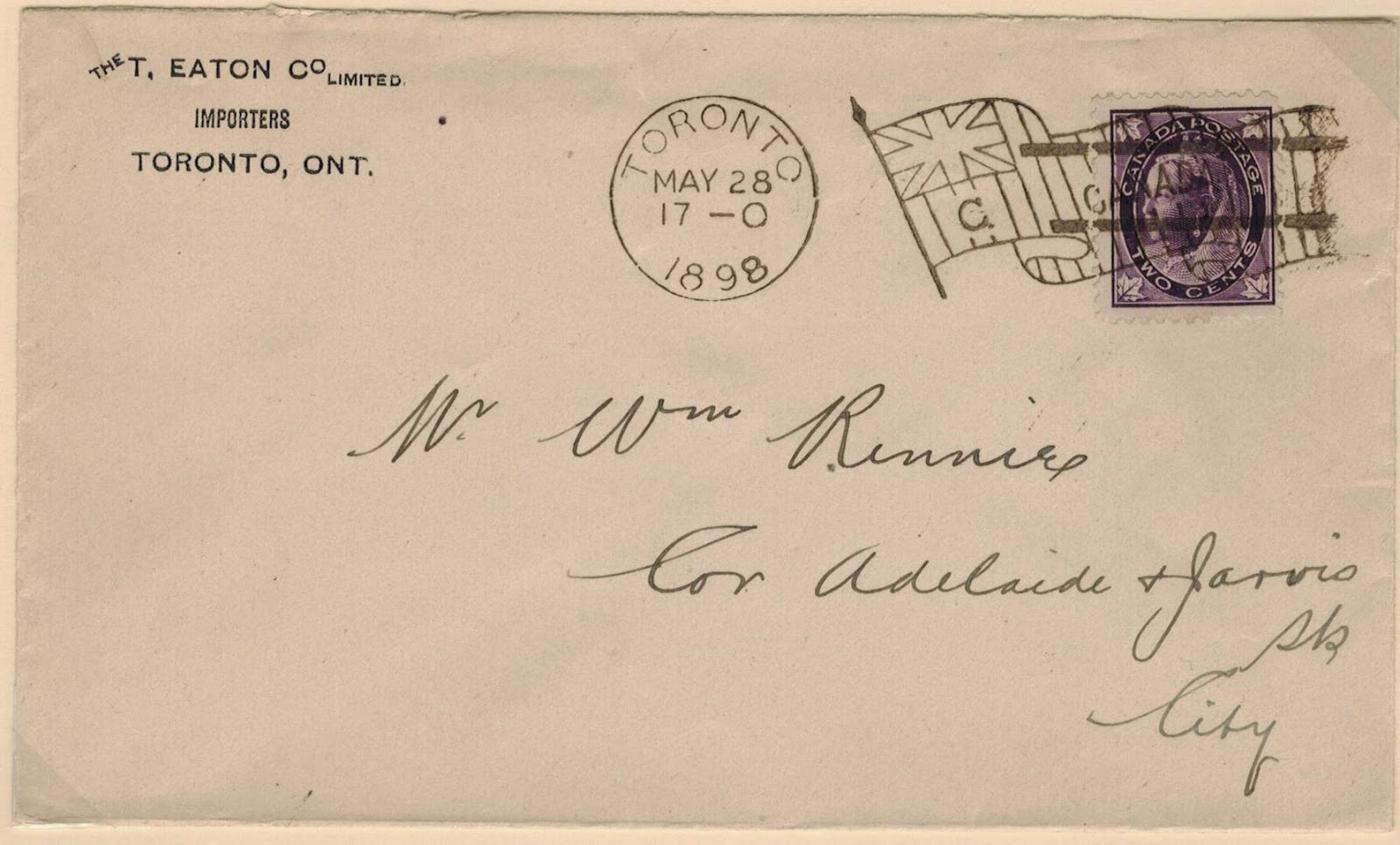
Toronto. local letter, May 28, 1898
2 cents local letter rate because Toronto had free letter carrier delivery
Winnipeg

Winnipeg. local letter, May 28, 1898
2 cents per ounce local letter rate because Toronto had free letter carrier delivery
4 cents paying the 2 ounce local letter rate
Hamilton
Hamilton. local letter, September 24, 1897
2 cents local letter rate because Hamilton had free letter carrier delivery

Hamilton. local letter, August 25, 1899
2 cents local letter rate because Hamilton had free letter carrier delivery

Letter carrier handstamp

Hamilton. local letter, February 27, 1906
2 cents local letter rate because Hamilton had free letter carrier delivery

Vancouver letter carrier section 1904
Archives Canada
(3) Local Letters : Cities without Free Letter Delivery
The rate was 1 cent for each ounce.
Saint John

St. John local letter, may 6, 1898
1 cent local letter rate because there was no free letter carrier delivery
Moncton
Letter carrier delivery was introduced in Moncton on September 26, 1908.

Moncton local letter, January 20, 1906
1 cent local letter rate because there was no free letter carrier delivery
c) Postage Rates from August 8, 1908
On August 8, 1908, the extra cent charged for local letters in the twenty-seven cities with free letter carrier delivery was removed. There were now only two letter rate categories:
1. Forward : 2 cents per 1/2 oz.
2. Local: 1 cent per 1/1 oz.
1. Forward : 2 cents per 1/2 oz.
2. Local: 1 cent per 1/1 oz.

Montreal local letter, December 29, 1908
Free local carrier delivery
1 cent local letter rate

Kitchener letter carriers, 1908
Archives Canada
F. Letter Carrier Handstamps
Montreal

Ste Martine to Montreal, June 28, 1890
1 cent post card rate
Montreal receiver July 1, 1890

Montreal carrier handstamp
July 1, 1890

Montreal local post card, September 26, 1893
1 cent post card rate

Montreal carrier handstamp
September 26, 1893
London

Toronto Hamilton and London RPO (W) to London, April 17, 1900
1 cent post card rate

London letter carrier handstamp
AM April 18, 1900
References
To follow