Sunday, October 9, 2011

S.S. France and Framexphil 1967


SS France was the French Line (Compagnie Generale Transatlantique) flagship from 1961 to 1974, combining regular transatlantic crossings, with occasional winter cruises, as well as two world circumnavigations. At the time of her construction she was the longest passenger ship ever built, a record that remained unchallenged until the construction of the RMS Queen Mary 2 in 2004.

Canadian Cruises

The SS France's first cruise to Canada was in May, 1967. The cover below is a souvenir of that event.


Quebec, May 9 1967


Quebec, May 10, 1967

Slogan cancellation:
SEMAINE
DE LA FRANCE
A QUEBEC
4 - 14 MAI 1967

FRAMEXPHIL and Expo 67

In July, 1967, the France docked at Montreal's Ile Notre-Dame, the site of Expo 67, and acted as a secondary French Pavilion. The Framexphil stamp exhibition was held on board the France. To mark the occasion the Quebec City post office used a slogan cancellation:

FRAMEXPHIL PAQUEBOT FRANCE 18 JUILLET 1967


Quebec, July 11, 1967


France Expo Stamp : Framexphil Cachet


Framexphil Souvenir Booklet

A souvenir booklet (22 cm x 22 cm) was prepared for the event.


Front Cover


Expo 67 Canada Pavilion cancellation, June 30, 1967


French Expo stamp : Framexphil S.S. "France" cancellation


S.S. Flandre Montreal Sailing 1967


The FRAMEXPHIL announcement shown below states that the winning ticket number for a free trip to Montreal on board the S.S. Flandre was drawn on July 7, 1967.


The S.S. Flandre was built for the French Line and operated on the Atlantic run and Caribbean cruises from 1952 to the late 1960s.

 .......................................................................................................................................................................

1971 S.S. France

The cover below from the S.S. "France" received the Quebec City paquebot machine cancellation.

Quebec to LeHavre, November 2, 1971


Saturday, October 8, 2011

The Royal Society of Canada

The Royal Society of Canada , founded in 1883, is the national body of distinguished Canadian scholars, artists and scientists whose objective is to promote learning and research in the arts and sciences. The Society was founded by the Marquis of Lorne , who was then Governor General of Canada. Since the 1880s, succeeding governors general have remained closely involved with the affairs of the society. One of the functions of the President of the RSC is to serve on the Governor General’s advisory council for appointments to the Order of Canada.

The covers shown in this posting are examples of correspondence mailed by the Society. Since the Society was granted free mail privilege, postage stamps were not affixed to the envelopes.


1890 Correspondence


The above cover was addressed to George Carslake, Montreal, and mailed on May 29, 1890.


Printed on the back of the cover is " Royal Society of Canada"


Points of Interest

1. John George Bourinot Frank

Free mail matter required a signature (frank) of the person or representative entitled to the free mail privilege.


Sir John George Bourinot (1836 – 1902) was a founding member of the Royal Society of Canada who acted as its honorary secretary. In 1892 he served as president of the Society. Bourinto was a journalist, historian, and civil servant, widely regarded and remembered as an expert of parliamentary procedure and constitutional law.


2. Registration

According to the 1890 post office regulations, the free mail privilege did not include registration. Nevertheless, an Ottawa "Registered Free" handstamp was applied.


The author would appreciate information regarding the use of this handstamp.


1936 Correspondence

The cover below was also registered and mailed to Minneapolis on March 3, 1936. Franked correspondence posted in Canada and addressed to the United States was delivered in the United States free of postage (Reg. 414, Canada Official Postal Guide 1936-1937).


The correspondence was franked by Charles Stewart.

Wednesday, October 5, 2011

Postcards to Belgium :
Fully Prepaid and Underpaid

This post looks at two post cards mailed from Canada to Belgium at the turn of the 19th century.

The first post card, shown below, was prepaid correctly at the 2 cents UPU post card rate.


Toronto to Brussels, April 17, 1898
2 cents UPU post card rate


The second card was underpaid 1 cent and taxed by the Canadian and Belgian Post Offices.The deficient postage on short paid post cards to Universal Postal Union countries was calculated in centimes of the Latin Monetary Union. Several European countries maintained their currencies at par with the French franc which was based on the gold standard. Belgium was a member of the Latin Monetary Union.


Quebec to Namur, September 1, 1900
2 cents UPU post card rate short paid 1 cent.

Canadian Taxation : T 5


According to the UPU rules, the despatching country marked the single deficiency due in centimes. The conversion rate was 1 Canadian cent = 5 centimes. The T 5 handstamp indicated that the amount underpaid was 5 centimes.

Belgian Taxe

The Exchange Office receiving the underpaid item doubled the amount shortpaid. That amount would be converted from centimes to local currency if the country of destinations's currency was not at par with the French franc. In this case no conversion was necessary and the amount to be collected was 10 centimes, double the deficiency.

.

Belgian taxe was 0.10 franc (10 centimes). Amount due written with blue pencil.


Postage Due Stamp

The Belgian 10 centimes postage due was applied in an interesting fashion. The Belgian Post Office folded the card vertically down the middle and sealed the halves with the postage due stamp. This prevented the addressee from reading the contents of the card until the taxe was collected.


Tuesday, October 4, 2011

Cricket in 19th Century Canada

As the Canadian men’s cricket team prepared for the 2011 Cricket World Cup, Jason Kenney, Minister of Citizenship, Immigration and Multiculturalism issued this statement:
“Cricket is a game with a long history here in Canada. Many Canadians may not know this, but cricket was designated Canada’s first national sport thanks to Sir John A. Macdonald. And the game was played on Canadian soil as early as 1785 in Montreal."
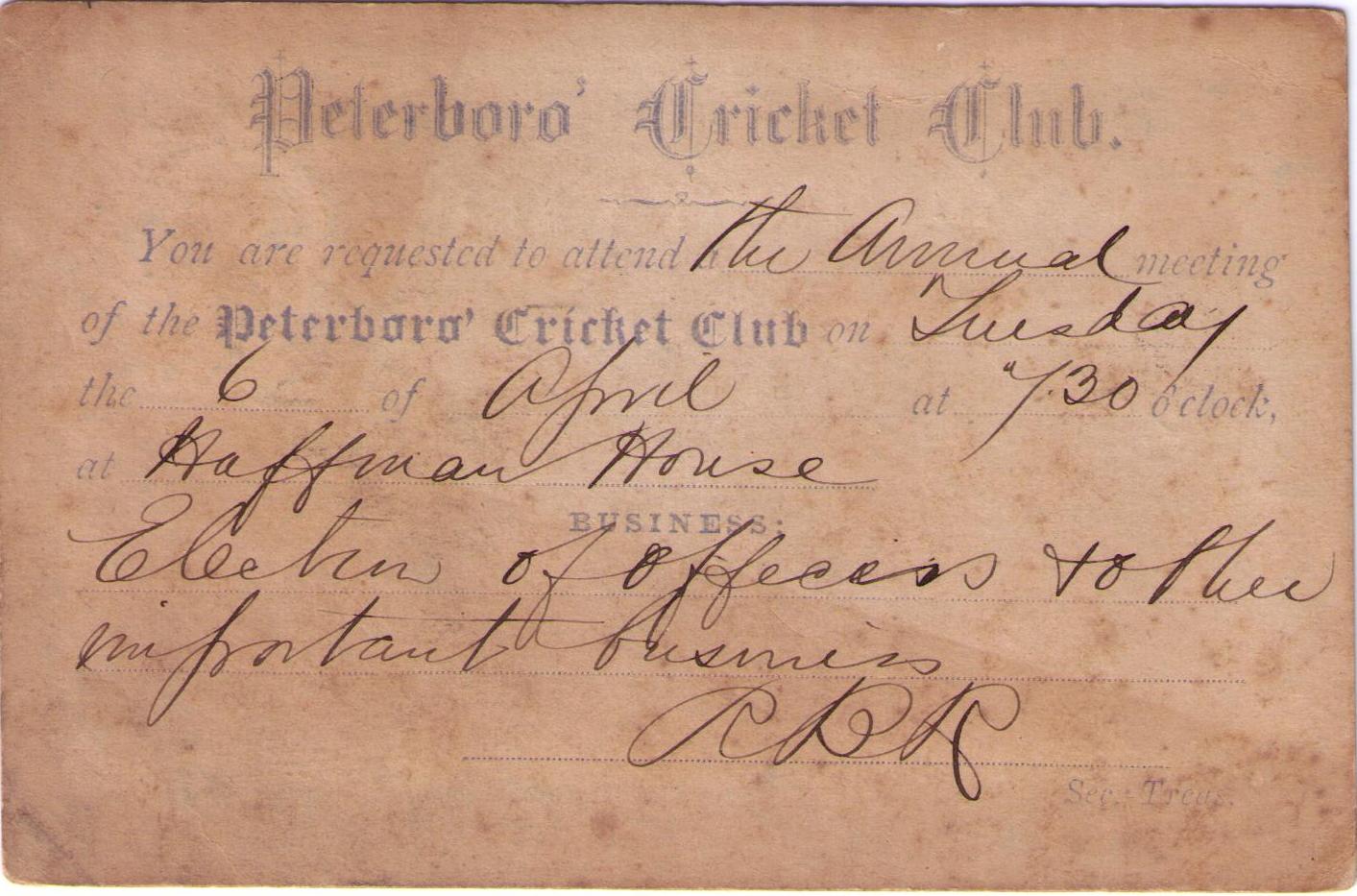
In the last half of the 19th century, Canadian communities such as Peterborough, Ontario, were particularly fond of the game. The card shown below was sent by the Secretary-Treasurer of the Peterboro' Cricket Club, advising members of its annual meeting.


The meeting was scheduled for Tuesday, April 6. Although the year was not provided, the card was sent in 1886.


There were no postal markings on the front or back of the card.


The Secretary-Treasurer initialed the notice : RBR.


RBR was civil and mechanical engineer Richard Birdsall Rogers, one of Peterborough's well known citizens and avid cricketers.


Richard Birdsall Rogers
McGill graduation

Trent University has posted excerpts from Rogers' diaries on its website. Here is an 1886 entry about cricket written two months after the Annual Meeting:
June Wednesday 17: Played cricket Toronto vs. Peterboro, score 95 and 134 Peterboro and 120 Toronto. Made 20 & 24
Trent Canal
Rogers is remembered today, but not for his skills on the cricket pitches of Ontario. Rogers is considered one of Canada's greatest engineers for his design of the Peterborough Lift Lock, the highest hydraulic boat lift in the world.

In 1884 Rogers was appointed supervising engineer of the Trent Valley Canal, a system linking Lake Ontario with Lake Huron. While serving as Superintendent of the Trent Canal, he suggested the use of hydraulic lift locks. Construction began on the Peterborough Lock in 1896 and was completed in 1904. The lock remains in use today as part of the Trent-Severn Waterway which is used for lumbering, steam-boating, power generation, and recreation.


Opening Day 1904


A more recent photograph of the Lock

In 1998, Canada Post issued a set of stamps featuring Canals. The Hydraulic Lift Lock was featured on one of the stamps.


National Archives of Canada


For additional information on Richard Birdsall Rogers, readers should visit the Trent University website.

Monday, October 3, 2011

The London Assurance
Promotional First Day Covers

The London Assurance produced several promotional first day covers for stamps issued by Commonwealth countries in the 1950s. Some of the London Assurance output is shown in this post.

1. Canada

1953 Wildlife


1954 Prime Ministers


1958 Quebec City 350th Anniversary


2. Other Commonwealth Countries

a) Coronation of Queen Elizabeth

Ceylon


Cyprus


Kenya


Mauritius


Malta


Nyasaland


South Africa


b) 1954 Royal Visit

Malta


Uganda Kenya Tanganyika


c) Other Issues

Ceylon : Colombo Plan Exhibition


Malta : The Immaculate Conception


Rhodesia and Nyasaland : Central African Rhodes Centenary Exhibit


Southern Rhodesia : Central African Rhodes Centenary Exhibit


Rhodesia and Nyasaland : Definitives