Saturday, December 22, 2012

Canadian Military Force "C" Hong Kong

Canadian troops of "C" force were sent to Hong Kong in November, 1941 to reinforce the colony's defences from possible Japanese attack.

"C" Force troops sailing for Hong Kong, November, 1941

 Battle of Hong Kong

On December 8, 1941, Japanese forces invaded Hong Kong and following seventeen days of combat defeated the Hong Kong defence force.

Of the 1,975 Canadians from the Royal Rifles and Winnipeg Grenadiers who went to Hong Kong, approximately 290 Canadian soldiers were killed in battle. Those who survived the battle became Prisoners Of War (POWs) and many endured torture and starvation by their Japanese captors. Approximately 264 more died while in captivity, for a total death toll of 554. In addition, almost 500 Canadians were wounded.


POWs

In the prison camps, Canadian POWs became weak and malnourished from a starvation diet. They lived in primitive huts and were forced to work in construction projects, shipyards and mines.

Canadian POWS in Japanese camp


Correspondence to POW

The cover below was mailed from Winnipeg on November 16, 1942, to Private Morris Peterson of the Winnipeg Grenadiers who had been "Taken Prisoner of War in Hong Kong".


Memorials

Hong Kong

The Sai Wan War Cemetery locate in Chai Wan, Hong Kong contains the graves of the soldiers who died during the Battle of Hong Kong.

Sai Wan War cemetary
The Sai Wan Bay Memorial includes the names of 228 Canadians who died in the defence of Hong Kong.

Ottawa

 The Hong Kong Memorial Wall, unveiled in Ottawa  on August 15 2009,  is a six-metre granite wall, etched with the names of all the Canadians who fought in the Battle of Hong Kong.  On one side are the names of the 961 members of the Royal Rifles, and on the other side are the names of 911 Winnipeg Grenadiers.  The 106 members of brigade headquarters, including doctors, dentists and chaplins, are listed on either end of the memorial. 


 MEMORIAL WALL  IN OTTAWA, CANADA  HONOURING VETERANS OF THE BATTLE OF HONG KONG


Wednesday, December 19, 2012

Japanese Canadian Relocation WWII

This post deals with the forced movement of more than 21,000 Japanese Canadians during World War II showing covers related to the relocation.


Tashme Internment Camp, April 30, 1943


In 1942,  shortly after Canada's declaration of war against Japan, Japanese-Canadians living 100 miles inland from the West Coast were removed by government order. The order affected more than 21,000 Japanese Canadians. “Military necessity” was used as a justification for their mass removal and incarceration despite the fact that senior members of Canada’s military and the RCMP had opposed the action, arguing that Japanese Canadians posed no threat to security.

A. Internment Projects Outside the Protected Area

1. Road Camp Projects

 Between March and June, 1942, 2000 men were separated from their families and sent to road camps road. By October 1942 many were allowed to join families in the interior internment camps


2. Internment Camps

Most of the Japanese Canadians, 12,000, were sent to internment camps located in the isolated British Columbia interior.  Sites included Greenwood, Sandon, Slocan, New Denver, Tashme, Kaslo.


3. Self-Supporting Projects

About 1000 internees chose to go to less restrictive “self supporting projects”. They were required to to pay for their transportation, housing materials and living expenses but the families were able to stay together. 
 
4. Prisoner of War Camps

About 700 men were interned in Prisoner of War camps located at Petawawa and Angler, Ontario.


B. Sugar Beet Farms

Beet growers in Alberta and Manitoba made arrangements with the B.C. government to obtain Japanese workers to solve their labour shortage.  About 4000 internees opted for the farms but found living conditions were poor, medical facilities were inadequate and the pay minimal. The Japanese were not allowed to leave the farm to find other employment.


End of War

As the war was coming to an end, the federal government decided to remove all Japanese Canadians from British Columbia who were forced to chose between deportation to Japan after the war or moving east of the Rockies immediately. The deportations stopped due to public protest but 4,000 Japanese had left Canada after the war. On April 1, 1949, the last of the wartime restrictions were lifted allowing Japanese Canadians to travel freely and return to the West Coast.

In September 1988, the Government of Canada formally apologized in the House of Commons and offered compensation for wrongful incarceration, seizure of property and the disenfranchisement of Japanese Canadians during WW II.


Japanese Relocation Covers

Minto Mine to Kaslo

The cover below was sent from the "Self-supporting" project of Minto Mine to the Internment Camp at Kaslo, November 17, 1944. The letter was censored and received at Kaslo on December 2, 1944.


Minto Mine

Minto City (also called Minto Mine) was established in 1934 as a townsite for miners at the nearby Minto Gold mine. The mine closed in 1942 but Minto City became a "self-supporting" project.

Minto Mine, November 17, 1944
Kaslo

Approximately 1100 Japanesse Canadians were relocated to the internment camp at  Kaslo.

Kaslo, December 2, 1944


 Tashme Internment Camp

The Tashme internment camp was located 14 miles from Hope, B.C. The camp housed 2, 300 Japanese Canadians from 1942 to 1945. The camp's name was derived from the first two initials of B.C. Security Commission members TAylor, SHine, and MEad.

Tashme Internment Camp to Toronto , April 30, 1943


 Internal Japanese Canadian mail was censored


Southern Alberta, Sugar Beet Farms

The cover below was mailed by a Japanese correspondent from the southwestern Alberta sugar beet farming area of Barnwell, Alberta to the internment camp at Kaslo, November 24, 1943.

Received at Kaslo, December 1, 1943

Straightline censor handstamp

Tuesday, December 18, 2012

1949 : American Airlines Flight 157 Crash

On November 29, 1949, American Airlines Flight 157 carrying 46 passengers and crew from New York to Mexico City crashed at Love Field, Dallas. The flight crew of the  Douglas DC-6 lost one engine in mid-flight and lost control during its approach to Love Field. The plane slid off the runway crashing into several buildings. 26 passengers and two flight attendants died. The pilot, co-pilot, flight engineer and 15 passengers survived.


A Douglas DC-6 similar to the one involved in the Dallas crash

 The post card shown below was on board Flight 157.

Niagara Falls to Mexico City, November 28, 1949
10 cents air mail rate to Mexico
Shortpaid and taxed 24 centimes
Spanish Label

A label written in Spanish was affixed advising that the correspondence was found in this state in the wreckage of the air plane crash in Dallas, on November 29,1949.


Thursday, December 13, 2012

St. Helena

[ A recent acquisition of a 1949 Canadian cover to St. Helena has inspired this posting]


Napoleon in exile on Saint Helena

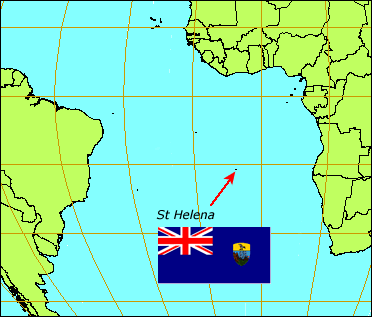
Saint Helena, the place of Napoleon Bonaparte's exile from 1815 until his death in 1821, is  located about midway between South America and Africa.. A British Crown  colony from 1834 to 1981, today  St. Helena is part of the British Overseas Territory of Saint Helena, Ascension, and Tristan de Cuha, Its reputation as one of the most isolated islands in the world should end in 2016 when St. Helena Airport, now under construction, is expected to open.


Royal Mail Ships


Prior to 1978, Union-Castle Line ships serviced Saint Helena. Since then, the British Government has operated ship service from Cape Town.

 (Not in author's collection) 
Built in 1947, the  R.M.S. "Edinburgh Castle" was one of the Union-Castle Line ships servicing St. Helena until the end of 1977.


(Not in author's collection)
The R.M.S. "St. Helena", in service since 1990,  is expected to cease operations upon completion of the St. Helena airport in 2016.

Mail From St. Helena

St. Helena to Chester, England, April 16, 1949
"VIA South Africa"
Redirected to Guernsey from Chester, May 16, 1949
St. Helena , April 16, 1949
 Transit time to England for the above cover was about one month.


Mail to St. Helena
  
1. Airmail

The commercial registered, air mail cover shown below was sent by Shafer-Haggart Ltd, Vancouver to Solomon & Co., St. Helena, June 10, 1949.

At that time, Shafer-Haggart Ltd. (now Shafer Commodities Inc. an agricultural trading company) was an exporter of canned west coast salmon and fruits and vegetables. Solomon & Company has dominated the trade of St. Helena since it was founded by Saul Solomon in the late 1700s. Today, Solomon's is involved in all aspects of the island's economy such as wholesaling, retailing, bulk fuel, bakeries, insurance, building, financial services, butchery and livestock. The St. Helena government bought a 32% share of Solomon's in 1968.

St. Helena receiver, July 9, 1949
One month transit

The air mail rate  to St. Helena was not listed  in the Official Postal Guide of the period. Since ship transit to St. Helena originated from Cape Town, it is likely that the cover was flown to South Africa, whose air mail rate was 25 cents per quarter ounce.

Assuming this was a registered, double weight ( one-half ounce) lette,r the total amount to be prepaid would have been 60 cents:


The amount affixed, 45 cents, was insufficient to prepay the postage and registration fee. The letter was taxed 45 centimes by the Canadian post office.

Postage Due 
  
Since the letter was registered, the following section of the Canada Official Postal Guide would have applied:
363. Registered articles are subject , in addition to regular postage, to a special registration fee of 10 cents to be prepaid by postage stamps. If, however, unpaid or insufficiently prepaid registered letters or postcards addressed to a Postal Union Country have been inadvertently accepted, they will be forwarded to destination under registration subject to collection on delivery of single the total deficiency as regards postage and registration fee.

 The amount due was therefore 15 cents or 45 gold centimes.


The registration may not have been requested by the sender but was assumed by the Vancouver post office, and which therefore resulted in single rather than double deficiency taxation. There is no indication that the St. Helena post office charged the addressee.

The transit time of one month for an air mail letter from Canada to St. Helena was slow,


2. Surface Mail

The transit time of one month for an air mail letter from Canada to St. Helena was slow,but the surface letter mailed from Toronto in 1949 took 2 months to arrive at St. Helena!


Toronto to Two Gun Saddle, St, Helena, February 11, 1949
4 cents British Colonies surface letter rate
St. Helena receiver, April 16, 1949

Tuesday, December 11, 2012

1949 Halifax Bicentenary

Britain took control of the peninsular part of Acadia  (Nova Scotia) from France in 1713. In 1749 the British government decided that a military station and settlement be built as a counterweight to the French fortress at Louibourg, Isle Royale (now Cape Breton).  Edward Cornwallis was assigned the task, and on June 21, 1749 arrived with 2500 settlers to begin the construction of Halifax.

Canada Post Office issued a commemorative stamp to mark the 200th anniversary of the founding of Halifax on June 21, 1949.


National Archives of Canada photographs related to the stamp issue have been posted on the Canadian Postal Archives website :

a) Edward Cornwallis
b) 18th Century Halifax
c) 20th Century Halifax


a) Edward Cornwallis


b) 18th Century Halifax

Several photographs of prints and paintings depicting 18th century Halifax were available as models for the stamp design.


c) Modern Halifax


The model used by designer H.H. Schwartz for the Halifax Bicentenary stamp was historical artist Charles W. Jeffrey's painting Founding of Halifax, 1749 depicting the building of the Halifax settlement.

National Archives of Canada
Founding of Halifax,1749 by C.W. Jeffrey

H.H. Schwartz stamp essay


 First Day Covers


Usages

Domestic


Renfrew to Hamilton, July 26, 1949
4 cents forward letter rate

Renfrew to Hamilton, July 26, 1949
4 cents forward letter rate

Toronto to Halifax, August 22, 1949
4 cents forward letter rate + 10 cents Special Delivery fee
International

Toronto to Prague, Czechoslovakia, July 8, 1949
15 cents air mail letter rate (one-quarter ounce) to Europe


Montreal to Manchester, England, June 30, 1949
15 cents air mail letter rate (one-quarter ounce) to Europe
Shortpaid 8 cents and taxed 48 gold centimes
(16 cents double deficiency X 3 gold centimes/cent = 48 gold centimes)