House of Commons Mail
Part III
16th - 20th Parliaments (1926 - 1949)
This post is the third in a series dealing with mail from the House of Commons. In this part, mail from the 16th to 20th Parliaments (1926-1949) is shown.
16th Parliament: December 9, 1926 - May 30, 1930
Prime Minister : William Lyon Mackenzie King
Franklin Smoke

Franklin Smoke (1860-1937) was the Conservative Member of Parliament for the Ontario riding of Brant from 1926 to 1935. Smoke attended public and secondary schools at Paris, Ontario then proceeded to studies at Osgoode Hall Law School. In 1908, he was appointed King's Counsel.
 Franklin Smoke

Franklin Smoke to Jacksonville, Fl., March 28, 1930
Thomas Merritt Cayley
Thomas Merritt Cayley (1878 – 1933) was the Liberal Member of Parliament for the riding of Oxford South from 1926 to 1933. He spent 18 years teaching in the public schools of Ontario, the last 13 in Norwich while for 4 years he was principal of the Norwich Continuation School. He was secretary treasurer of the Otter Mutual Insurance Company and secretary-treasurer of the Mutual Fire Underwriters of Ontario.
 Thomas Merritt Cayley

Thomas Merritt Cayley to Norwich, June 6, 1928
 Correspondence from Thomas Cayley
17th Parliament: Sept. 8, 1930 - August 14, 1935
Prime Minister : Richard Bennett
Charles Marcil
Correspondence from Thomas Cayley
17th Parliament: Sept. 8, 1930 - August 14, 1935
Prime Minister : Richard Bennett
Charles Marcil
Charles Marcil,
(1860 – 1937) was was first elected to the House of Commons as a Liberal Member of Parliament in the 1900 election and represented the Quebec riding of Bonaventure until his death in 1937. Marcil served as Speaker of the House from 1909 to 1911.

 Charles Marcil

Charles Marcil to Ottawa (re-directed to Quebec) , April 14, 1932
J.S. Woodworth
 James Shaver Woodsworth
 is considered to have been one of the half-dozen most important national political figures in twentieth-century Canadian history. The Canadian Museum of Civilization's website provides this biography of J.S. Woodworth:
Born in Ontario but raised in Manitoba, James Shaver Woodsworth (1874–1942), was a Methodist clergyman, social worker, politician, and the first leader of the Co-operative Commonwealth Federation.
Woodsworth started out as a Methodist clergyman in 1896, but had become a social worker in Winnipeg’s North End by 1904. His experience of urban slums convinced him that socialism was the solution to poverty. Despite being fired from his position as a government social researcher in 1917 for being a pacifist and arrested for libel during the 1919 Winnipeg General Strike, Woodsworth’s ideals made him a popular Winnipeg politician.
His popularity led to his election as the Member of Parliament for Winnipeg North Centre in 1921, a riding that he held until his death. As a Member of Parliament, Woodsworth consistently campaigned for labour rights, improved social welfare measures and democratic socialism. Although he failed to make socialism a reality in Canada, he succeeded, in 1926–1927, in persuading Prime Minister Mackenzie King to introduce an old-age pension plan — Canada’s first social welfare legislation — in exchange for providing the votes Mackenzie King needed to stay in power.
 J.S. Woodsworth

J.S. Woodsworth to Winnipeg, February 18, 1933
Agnes Campbell Macphail : Canada's First Female M.P.

In 1919 the
Election Act was amended so that any British subject of the full age of 21 years, male or female, might be a candidate for election to the House of Commons. In the following general election, in 1921, Agnes Macphail was one of four women who ran for election, but she was the only one elected. She took her seat in the House of Commons on March 8, 1922, and was a member until the general election of 1940, when she was defeated. She was subsequently elected to the Ontario Legislature as a CCF candidate in 1943 and 1948.
Agnes Macphail (1890 - 1954) had been a school-teacher, and ran for election under the banner of the United Farmers of Ontario. However, she had been a member of the CCF from its foundation, and was essentially a farmer-Labour representative. She was deeply interested in the organization of co-operatives for the marketing of farm products. She also was keenly concerned with working conditions, and personally investigated conditions in the Cape Breton mining area in the early 1920's. Perhaps her most important contribution, however, was to prison reform. She was largely responsible for the setting up of a Royal Commission in 1936 to study the Canadian Penal system.

Agnes Campbell Macphail

Agnes Macphail to Guelph, May 10, 1933
Robert James Manion

Robert James Manion (1881-1943) was a physician and politician. He was elected MP for Fort William from 1925 to 1935. Following the election of 1930, Conservative Prime minister R.B. Bennett appointed Manion Minister of Railways and Canals. Manion was defeated in the 1935 federal election.
In July 1938 Manion was elected leader of the Conservative Party. Manion won a by-election in London later that year and opposed conscription after WWII broke out. Hostility from hard-line Toronto Tories over his nonconscription policy, contributed to the party's poor showing in the March 1940 election. He lost his own seat and resigned his party leadership in May of that year.
 Robert James Manion Minister of Railways and Canals


Robert James Manion to Port Arthur, March 25, 1935
Eusebe Roberge
Eusebe Roberge was the Liberal Member of Parliament for the Quebec riding of Megantic from 1922 to 1935 and Megantic-Frontenac from 1935 to 1940.

 Eusebe Robert

Eusebe Robert to Montreal, February 19, 1934
George Brecken Nicholson
George Brecken Nicholson was the M.P. for the Ontario riding of Algoma East from 1918-1926 (Unionist), 1926 and 1930-35 (Conservative). In business, he was part of the lumber firm Austin and Nicholson and became president and secretary-treasurer of the McNaught Lumber company. Nicholson was also a director of the Excelsior Life Insurance company.

 George Brecken Nicholson

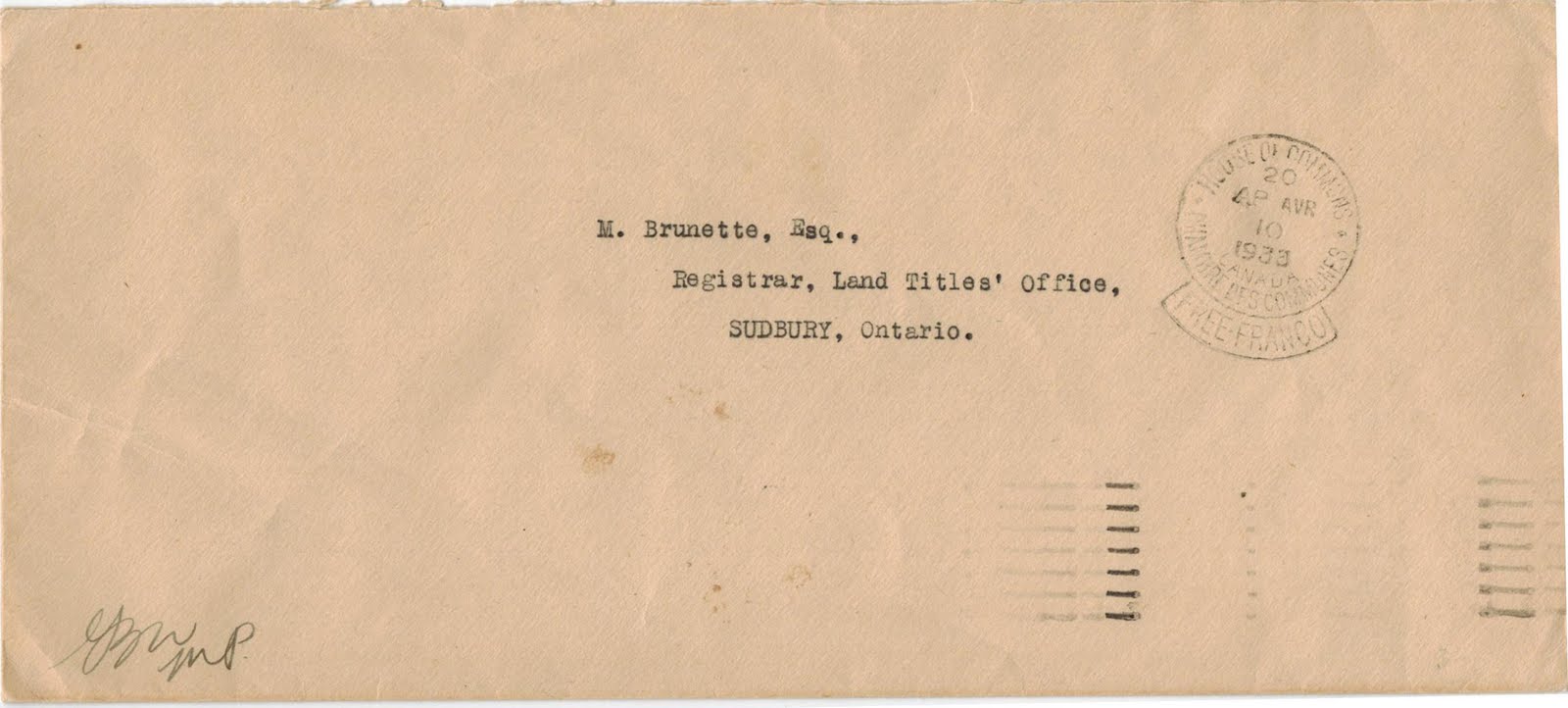
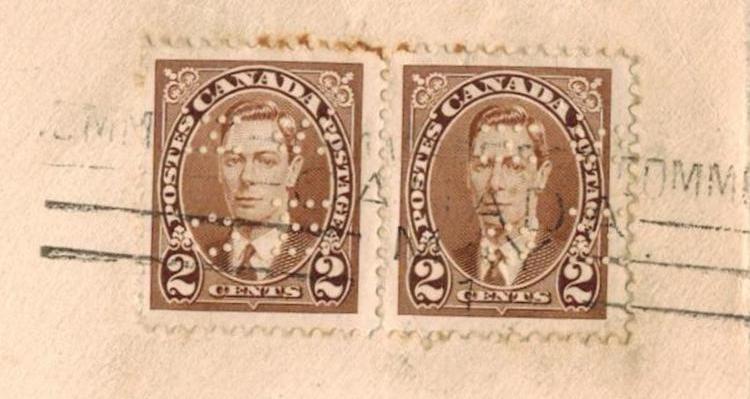
George Brecken Nicholson to Sudbury, April 10, 1933
Edgar Nelson Rhodes
Edgar Nelson Rhodes was the Conservative Member of Parliament for
Richmond-West Cape Breton, N.S.and served as Minister of Finance from
1932 to 1935
Edgar Nelson Rhodes
Ottawa to Chatham, September 29, 1934
18th Parliament: Feb. 6, 1936 - January 21, 1940
Prime Minister : William Lyon Mackenzie King
Almon Secord Rennie
Almon Secord Rennie (1882 – 1949) was the Liberal Member of Parliament for the Ontario riding of Oxford from 1935 t0 1945. A merchant by career, Rennie was mayor of Tillsonburg from 1922 to 1924 and served as a deputy reeve for Oxford County council.

 Almon Secord Rennie

Almon Secord Rennie to Norwich, February 11, 1939
Burton Maxwell Hill

Burton Maxwell Hill (1883-1963) was the Liberal Member of Parliament for the New Brunswick riding of Charlotte from 1935 to 1945. From 1918 to 1925, he was the New Brunswick provincial Deputy Minister of Public Works. In 1925, Hill became a full provincial minister of Public Works but resigned later that year after the government was defeated in an election where Hill did not win a seat. In 1929 and 1930, he was commissioner for the Saint John Harbour Board.
 Burton Maxwell Hill

Burton Maxwell Hill to Saint John, February 18, 1936
Douglas Gooderham Ross
 Douglas Gooderham Ross
 (1883 – 1961) was the Conservative member for the Ontario riding of St. Paul's from 1936 to 1949. Ross was vice-president of the Dominion of Canada General Insurance Company. Ross was not fond of CBC radio personality Max Ferguson's satirical
Rawhide show describing it in the House of Commons as "meaningless ravings and tripe" and as an insult to the intelligence of Canadians.
 Douglas Gooderham Ross

Douglas Gooderham Ross to Toronto, March 12, 1937
Harry R. Fleming
Harry Fleming M.D. (1894-1942) was the Liberal Member of Parliament for the Saskatchewan riding of Humboldt from 1936 to 1942.

 Harry R. Fleming

Harry R. Fleming to Melville, Sask., March 10, 1939
House of Commons Members Stenographers

Members Stenographer to Markdale, June 2, 1939

Members Stenographers
J.H.S.
Arthur Beauchesne : Clerk of the House of Commons
 Arthur Beauchesne
 (1876 – 1959) was a Canadian civil servant who was Clerk of the House of Commons from 1925 to 1949. He is the author of the procedural manual, Rules and Forms of the House of Commons of Canada, which is used by Canadian Members of Parliament during parliamentary debates. In 2003, he was designated a
Person of National Historic Significance.
 Arthur Beauchesne, Clerk of the House of Commons
Library of Parliament
Arthur Beauchesne, Clerk of the House of Commons
Library of Parliament


is the main information repository and research resource for the Parliament of Canada. The main branch of the library sits at the rear of the Centre Block on Parliament Hill and is the last untouched part of that larger building's original incarnation, after it burned down in 1916.

Library of Parliament to Toronto, April 26, 1939
Registered : House of Commons registration handstamp
Felix Desrochers : General Librarian 1933 -1956
The biography of Felix Desrochers can be found at the
Canadian Parliamentary Review website.
 Felix Desrochers, B.G. (Bibliothécaire Général)
Sergeant at Arms : Major Milton Fowler Gregg
Felix Desrochers, B.G. (Bibliothécaire Général)
Sergeant at Arms : Major Milton Fowler Gregg
Major Milton Fowler Gregg (1892 – 1978) was the recipient of the Victoria Cross, the highest Commonwealth award for gallantry "in the face of the enemy", during the First World War.
The citation for Gregg's Victoria Cross reads:
- Lt. Milton Fowler Gregg, M.C., R. Can. Regt., Nova Scotia R. - For most conspicuous bravery and initiative during operations near Cambrai, 27th September to 1st October, 1918.
- On 28th September, when the advance of the brigade was held up by fire from both flanks and by thick, uncut wire, he crawled forward alone and explored the wire until he found a small gap through which he subsequently led his men and forced an entry into the enemy trench. The enemy counter-attacked in force and, through lack of bombs, the situation became critical. Although wounded Lt. Gregg returned alone under terrific fire and collected a further supply. Then rejoining his party, which by this time was much reduced in numbers, and in spite of a second wound, he reorganized his men and led them with the greatest determination against the enemy trenches, which he finally cleared. He personally killed or wounded 11 of the enemy and took 25 prisoners, in addition to 12 machine guns captured in the trench. Remaining with his company in spite of wounds he again on the 30th September led his men in attack until severely wounded. The outstanding valour of this officer saved many casualties and enabled the advance to continue.

From 1934 until 1939 he was the Sergeant at Arms of the House of Commons. Following the outbreak of World War II , Gregg served overseas for two years and then commanded officer training centres at various military facilities in Canada.
In 1944, he was appointed President of the University of New Brunswick, serving in that position until 1947 when he was elected to Parliament as Liberal Member for York-Sunbury riding. Gregg served in the cabinets of Prime Ministers William Lyon Mackenzie King and Louis St. Laurent for almost ten years as the Minister of Fisheries, Minister of Veterans Affairs, and Minister of Labour.
 Milton F. Gregg Sergeant-at-Arms

Sergeant-at-Arms to Toronto, November 6, 1936
Tourist Mail : The Nursing Sisters Memorial
The post card shown below featured a photograph of the Nursing Sisters Memorial.

House of Commons to Clayton, N.Y., September 29, 1937
 The Nursing Sisters Memorial

The
Nursing Sisters' Memorial is located in the Hall of Honour in the Centre Block on Parliament Hill. The completed panel was unveiled during the summer of 1926 to honour the forty-six matrons and nursing sisters who lost their lives during the Great War.
19th Parliament : May 16, 1940 - April 6, 1945
Prime Minister : William Lyon Mackenzie King
William Henry Moore
William Henry Moore (1872 – 1960) was the Liberal Member of Parliament for the Ontario riding of Ontario from 1930 to 1945.
Moore, a lawyer, was also the author of several books dealing with culture and economics. According to Graham Fraser, Canada's sixth Commissioner of Official Languages:
"William Moore was an improbable defender of French-language rights in Canada. He was, as he listed proudly in his biography, of United Empire Loyalist descent, and a farmer in Pickering, Ontario. ...In 1918, when World War I was still raging and in the aftermath of Regulation 17, which abolished French-language education in Ontario, Moore wrote a remarkable book entitled The Clash: A Study in Nationalities. In the book, he argued that British traditions called for bilingualism and inclusion, and shrewdly contrasted them with what he called the rigid Prussian approach."

 William Henry Moore

William Henry Moore to Eden, February 23, 1942
James Angus MacKinnon

James Angus MacKinnon (1881-1958) was the Liberal Member of Parliament for the Alberta riding of Edmonton West from 1935 to 1949. He held many cabinet positions including Minister without Portfolio, Minister of Trade and Commerce, Minister of National Revenue (Acting), Minister of Fisheries, and Minister of Mines and Resources. In 1949, he was called to the Senate representing the senatorial division of Edmonton, Alberta. From 1949 to 1950, while a senator, he was a Minister without Portfolio in the cabinet of Louis St-Laurent.
 James Angus MacKinnon


James Angus MacKinnon to New York World's Fair, New York, July 4, 1940
Charles Stephen Booth

Charles Stephen Booth (1897-1988) was elected in 1940 as a Member of the Liberal Party to represent the riding of Winnipeg North. Prior to his federal political experience, he served overseas in the Western University Battalion, Canadian Expeditionary Force then in northern Russia as a pilot. In 1936 he became a lieutenant colonel and commander of the Winnipeg light infantry. From there he moved to London, England where he was placed with the 1st Canadian Corps Headquarters and promoted to colonel where he also achieved the ranks of Assistant Deputy Adjutant General, Brigadier and then Deputy Adjutant General.


Charles Stephen Booth to North Hatley, Quebec, July 17, 1943
House of Commons Reading Room
The Reading Room, located close to the Commons chamber, provided parliamentarians, staff, and members of the press gallery with an extensive collection of Canadian and foreign newspapers and periodicals including numerous local weekly papers. In 1990, the Reading Room was converted to a committee room. A detailed history of the House of Commons Reading Room can be found at the
Canadian Parliamentary Review website.
 House of Commons Reading Room
 House of Commons Reading Room
 handstamp

Huuse of Commons Reading Room to Hamilton, June 20, 1940
Arthur Beauchesne Clerk of the House of Commons handstamp
Brooke Claxton

Brooke Claxton was the Liberal Member of Parliament for the Quebec riding of St-Lawrence-St-Georges from 1940 to 1954. Claxton served as the Minister of National Health and Welfare and as Minister of National Defence.
Claxton contributions included establishing the CBC, building the welfare state, creating the modern Canadian military, and setting up the Canada Council.
 Brooke Claxton

Brook Claxton to New York, May 1, 1943
 House of Commons dated roller cancellation
Charles Edward Johnston
House of Commons dated roller cancellation
Charles Edward Johnston

Charles Edward Johnston (1899 - 1971) was a teacher and a politician. He served as the Social Credit Member of Parliament for the Alberta riding of Bow River from 1935 to 1958. He moved to provincial politics and served as a member of the Legislative Assembly of Alberta from 1959 to 1967 for the governing Alberta Social Credit party.
 Charles Edward Johnston

Charles Edward Johnston to Berkeley, Calif., April 5, 1943
4 cents surface letter rate + 10 cents registration fee
Almon Secord Rennie
Almon Secord Rennie (1882 – 1949) was the Liberal Member of Parliament for the Ontario riding of Oxford from 1935 t0 1945. A merchant by career, Rennie was mayor of Tillsonburg from 1922 to 1924 and served as a deputy reeve for Oxford County council.

Almon Secord Rennie to Lachine, February 16, 1943
 Rennie correspondence
Manley Edwards
Rennie correspondence
Manley Edwards
Manley Justin Edwards (1892 - 1962) was a barrister, teacher and Canadian federal politician. He was the Liberal Member of Parliament for the Alberta riding of Calgary West from 1940 to 1945.

 Manley Edwards

Manley Edwards to Toronto, March 5, 1941
Ralph Maybank
Ralph Maybank (1890-1965) was the Liberal Member of Parliament for the Manitoba riding of Winnipeg South Centre from 1936 to 1951. He held positions of Parliamentary Assistant to the Minister of Health and Welfare (October 1947 to January 1949), and Parliamentary Assistant to the Minister of Mines and Resources (January 1949 to July 1951). He was appointed a judge of the Manitoba Court of King's Bench in July 1951.

 Ralph Maybank

Ralph Maybank to Winnipeg, April 5, 1944
M. J. Coldwell
 Major James William Coldwell
 (1888 – 1974), was a social democratic politician and leader of the Co-operative Commonwealth Federation party from 1942 to 1960. Coldwell was the C.C.F. Member of Parliament for the Saskatchewan riding of Rosetown-Biggar from 1935 to 1958.
Coldwell was respected by his peers in other political parties and was offered Cabinet posts in provincial and federal governments, Speakership of the House of Commons and a Senate seat. He served as a member of the Canadian delegation at the creation of the United Nations. Coldwell was named to the Privy Council (1964) and made a Companion of the Order of Canada (1967). The Douglas-Coldwell Foundation, a left-wing educational organization, is named after two remarkable Saskatchewan political figures.

M. J. Coldwell

M. J. Coldwell to Montreal, March 24, 1945

Coldwell with a young David Lewis (N.D.P. leader 1971- 1975)
20th Parliament : September 6, 1945 - April 30, 1949
Prime Ministers:William Lyon Mackenzie King
Louis St. Laurent
Frederick Samuel Zaplitny
Frederick Samuel Zaplitny (1913-1964) was the C.C.F. Member of Parliament for the Manitoba riding of Daupin from 1945 to 1949 and 1953 to 1958.He operated an insurance and real estate brokerage in Dauphin, and he was president of the Dauphin Chamber of Commerce at the time of his death.

 Frederick Samuel Zaplitny

Frederick Samuel Zaplitny to Dauphin, April 6, 1949
Gaspard Fauteux
Gaspard Fauteux was the Liberal Member of Parliament for the Quebec riding of St. Mary from 1942 to 1949. In 1945, Fauteux was elected as Speaker of the House of Commons, a position he held until his resignation from the House in 1949. The following year he was appointed Lieutenant-Governor of Quebec, a position he held until 1958.


Gaspard Fauteux
 Speaker of the House of Commons

Gaspard Fauteux to the Italian Ambassador, Ottawa, November 15, 1948
Frank Lennard
Frank Lennard was the Progressive Conservative Member of Parliament for the Ontario riding of Wentworth from 1936 to 1940 and 1945 to 1962.

 Frank E. Lennard

First day cover sent by M.P. Frank Lennard, October 1, 1948
George Black

George Black (1873 – 1965) was an administrator and politician in Yukon Territory. He went to the Yukon in 1898 during the Gold Rush and prospected for gold, making a fortune and losing it when his claim was swept away in a flood. He then established a law practice in Dawson City.
During World War I, Black recruited a regiment from the Yukon to fight in the war. He became the company's Captain , and was wounded in combat.
Black was the Progressive Conservative Member of Parliament from 1921 to 1934 and 1940 to 1949. He served as Speaker of the House of Commons from 1930 to 1935. In 1935 he resigned his seat for health reasons. His wife, Martha Black, ran in his place as an "Independent Conservative". She held the seat, becoming the second woman elected to the House of Commons (the first being Agnes Macphail) , and the first American-born woman to do so.
In 1940 Martha stepped aside, allowing her husband Black to run for the Yukon seat which he held until 1949.
 George Black

George Black to Ketchikan, Alaska, June 13, 1947
Library of Parliament : Francis Aubrey Hardey
Francis Aubrey Hardy was the Parliamentary Librarian from
1944 - 1959.
 Francis Aubrey Hardy

Library of Parliament to Victoria, August 20, 1945